 China Heritage Classroom
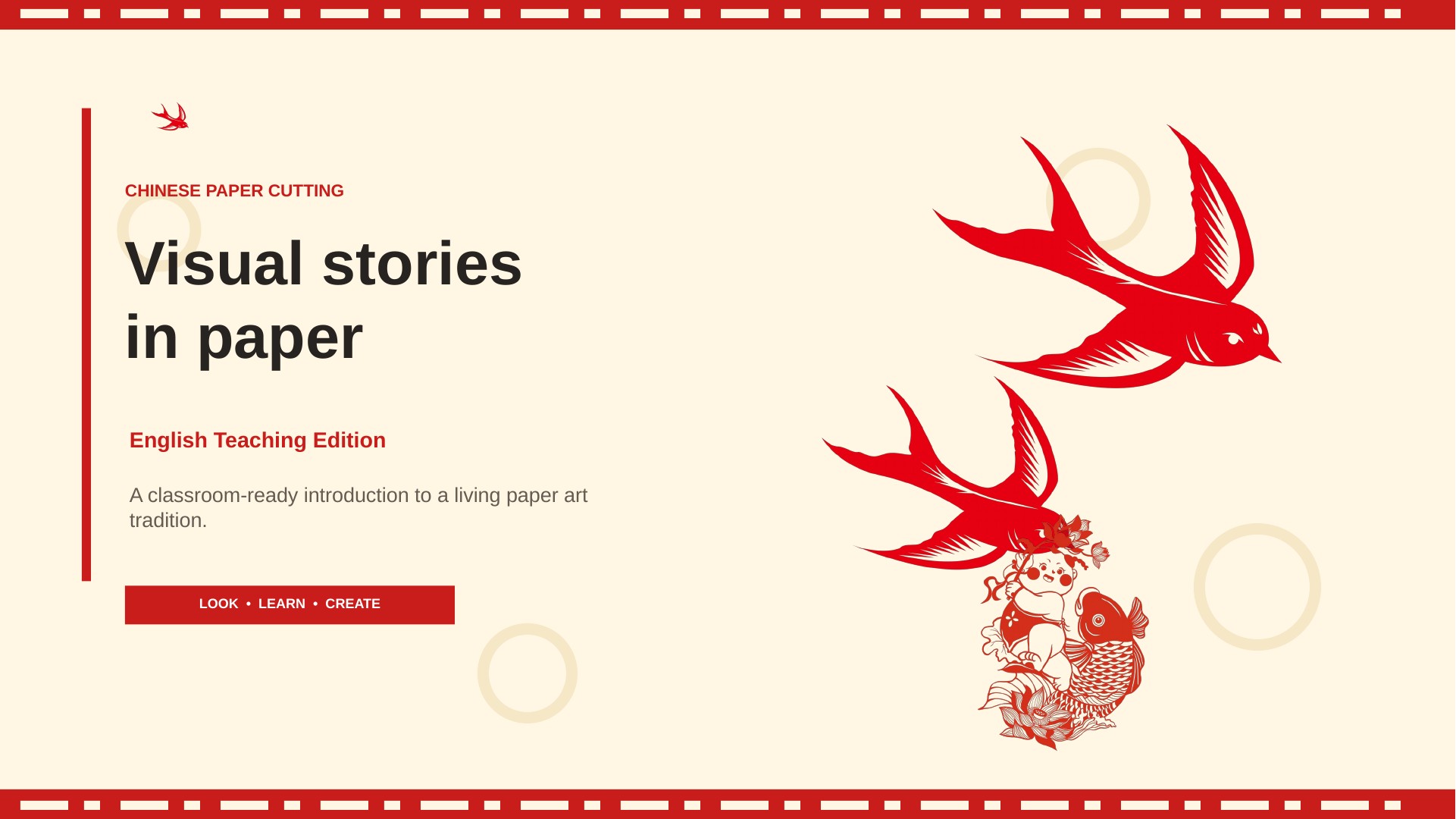
Look at the spaces between the shapes
Show a paper-cut image and give the class a moment to look in silence. Ask students to name something that remains on the sheet, then something that has been removed. In paper cutting, the opening can be just as important as the paper around it. It may form a line, let in light, or help an image stand out against a window.
The English Chinese Paper Cutting PPTX introduces the art form through this relationship between positive space (paper that stays) and negative space (paper that is cut away). It then uses repetition, symmetry, colour, and regional examples to help students explain what they can actually see.
Lesson at a glance: Use the full slide route over 15–45 minutes, or choose the observation and design sections for a shorter class. Students need a paper-cut image to study and paper for a pencil sketch. The deck’s activity is about planning and explaining a design; it does not depend on students cutting paper.
Place the art in a living tradition
Chinese paper-cut appears in homes and at celebrations, including as window decorations and handmade gifts. Styles and motifs vary by place and purpose. UNESCO inscribed Chinese paper-cut on its Representative List of the Intangible Cultural Heritage of Humanity in 2009. This is a useful point for discussion: a tradition can be passed on while makers continue to change it.
The PPTX compares broad silhouettes with delicate lines and denser detail. Ask learners to compare the visible choices in two examples before drawing conclusions about a region. This keeps the conversation grounded in the artwork rather than turning regional descriptions into rigid rules.
A classroom route from observation to design
- Look, 5 minutes. Show one image. Ask: “Where does a gap become part of the picture?” Have students point to both the paper and the openings.
- Name, 5–10 minutes. Introduce silhouette, symmetry, openwork, and motif. Students describe two lines or shapes using at least one of these words.
- Compare, 5–10 minutes. Show a second example. Which image uses a bolder outer shape? Where are the finer openings? Invite more than one supported interpretation.
- Design, 10–20 minutes. Students sketch a motif for a celebration or a place. They mark the areas that would stay and the gaps they would remove. A simple drawing is enough.
- Share, 5 minutes. Each student explains what their motif shows and points to one visual choice that helps tell the story.
Keep the discussion specific
“I like it” is a starting point. “The repeated openings make the flower look balanced” shows closer observation. The PPTX includes a vocabulary slide and a sentence stem, “I can see ___ because ___,” for learners who need support. You can ask students to use it once before they explain their own sketch.
To check understanding, collect a drawing with two labels: one for paper that stays and one for a gap. A short sentence should explain what the motif is meant to communicate. This lets students show visual understanding even when the class does not have time for a physical cutting activity.
Use the matching PPTX lesson
The English Chinese Paper Cutting deck includes examples for close looking, vocabulary support, regional comparisons, and the “tell a story in paper” activity. It is one of 12 editable PPTX lessons in the bundle.
View the Paper Cutting cover and bundle details ↗