 China Heritage Classroom
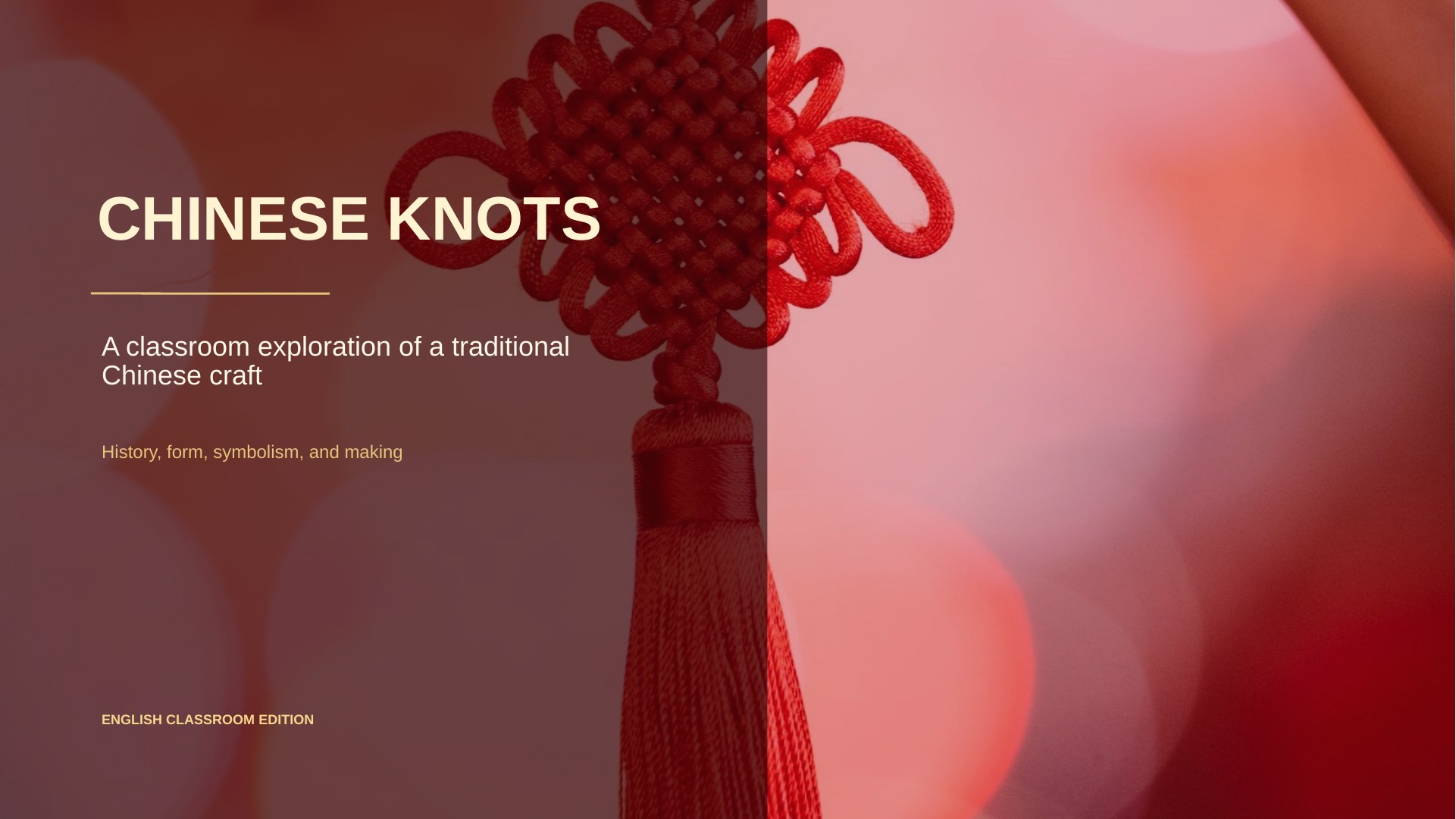
Begin with a familiar object
Ask students what they have tied today: a shoelace, a bag, or perhaps a cord on a coat. This opens the lesson with a useful question: when does a knot become something we notice for its appearance or meaning?
The Chinese Knots PPTX moves from practical uses of cord to decorative forms. Its examples include clothing ties, cords for pendants, and loops used to carry small objects. A slide about knotted cords and memory makes a good discussion prompt about how people record information. Present that as a cultural idea, without treating knots as a complete writing system.
Lesson at a glance: Allow 45–60 minutes. Prepare red cord or yarn, tape for fraying ends, and an optional blunt hook or tweezers. Students will describe a knot’s shape, discuss an association, and try the first moves of a flat knot.
Give students a way to look closely
Show a knot image and ask learners to trace the cord with a finger. Where does the path cross itself? Which loops repeat? Are the two sides balanced? These questions bring attention to form before students try to interpret it. The deck’s “How to Read a Knot” slide gives four useful features to notice: a continuous cord, repeated loops, balanced sides, and a shaped centre.
Next, compare names and good wishes from the deck. The Double Coin form is associated with prosperity; the Peace Knot points to safety and peace. Students can also discuss the Endless Knot’s continuous path and its association with continuity and longevity. Meanings vary across families and regions, so invite students to explain what they see instead of memorising a single fixed interpretation.
A 45–60 minute lesson sequence
- Notice, 5–10 minutes. Start with familiar knots, then show a decorative form. Ask what changes when a useful tie becomes an ornament.
- Read the form, 10 minutes. Trace its path and identify loops, crossings, open spaces, and symmetry. Let pairs describe the same image in different words.
- Connect form and meaning, 10 minutes. Introduce two knot names from the word bank. Ask which part of each design might help someone remember its good wish.
- Make and explain, 15 minutes. Demonstrate one crossing at a time. Students anchor a centre cord, cross the right end over it, bring the left end under and through the loop, then pull both ends gently. Repeat on the opposite side to build a flat band. Pause before each tightening step.
- Share, 5 minutes. Students name a good wish and write one sentence linking it to a detail in the form they made or observed.
What to listen for
A useful answer names something visible: “The repeated loops make the two sides look connected.” Ask a follow-up when students jump straight from a shape to a meaning: “Which line, loop, or gap helped you decide?” Students who find the cord work difficult can trace or sketch the path and still take part in the discussion.
The lesson ends with a small object and a clear explanation. Students have seen how function, form, and personal interpretation can meet in one craft tradition.
Use the matching PPTX lesson
The English Chinese Knots deck includes the visual examples, word bank, flat knot steps, and pair activity described here. It is one of 12 editable PPTX lessons in the complete bundle.
View the Chinese Knots cover and bundle details ↗